



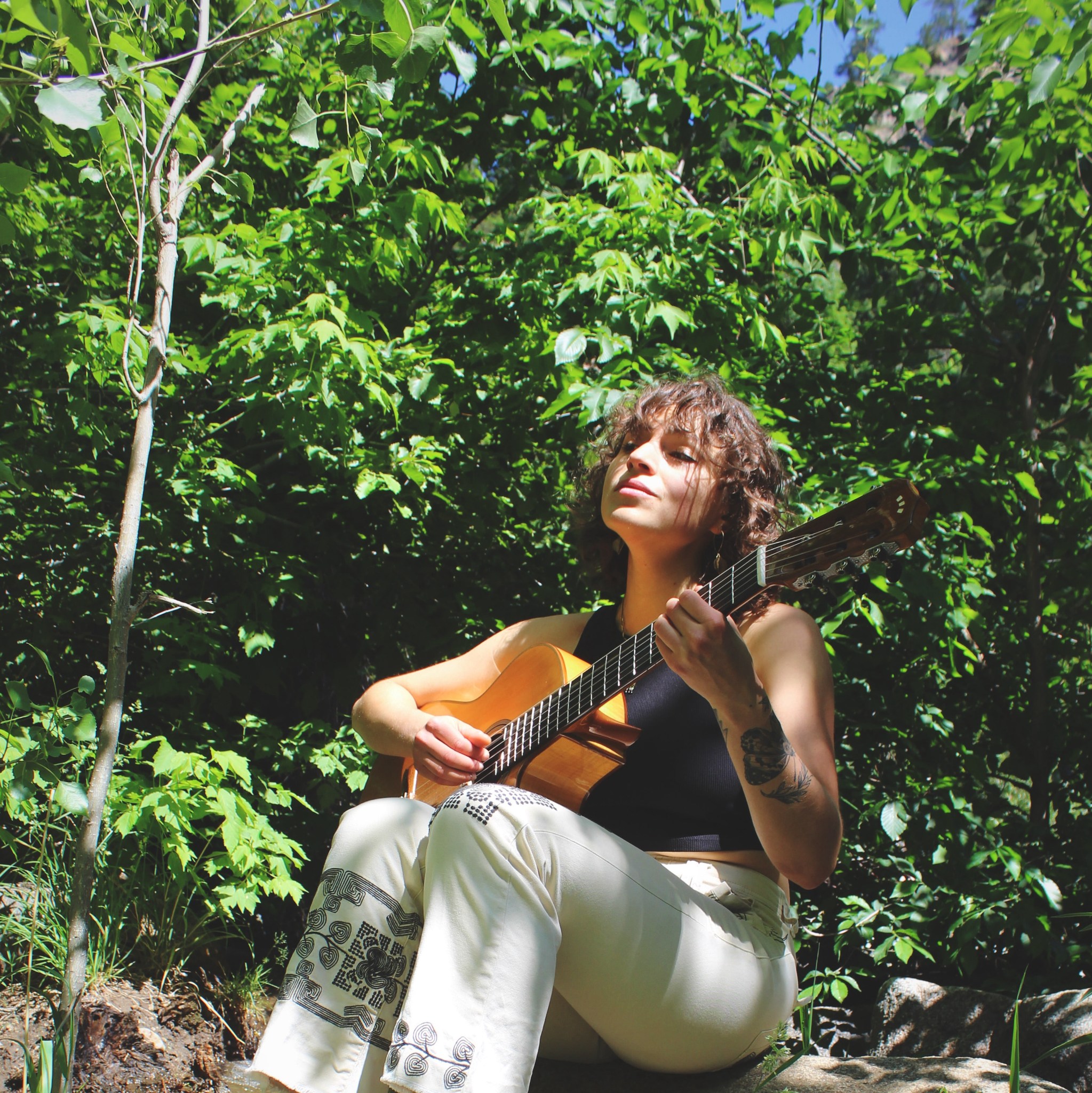
For Denver-based singer-songwriter Olivia Roumel, music isn’t just about melody—it’s about capturing fleeting moments, emotions and sonic landscapes with deep intention. With a background in songwriting, performance and production, Roumel’s artistry is a carefully curated experience, shaped by years of exploration and a sharp ear for sonic detail. Her latest project, I Take A Picture With My Whole Being, is a testament to her evolving sound, blending intricate vocal layering, dynamic rhythmic structures, and raw, unfiltered storytelling.
For this edition of Soundtrack to My Life, Roumel curated a playlist of reference tracks — a refined selection of songs that have influenced her current creative process—both sonically and emotionally. Featuring vocal powerhouses like Joni Mitchell, Amy Winehouse, and D’Angelo, as well as genre-blurring artists like Hiatus Kaiyote and Björk, her selections highlight an appreciation for textured music, unfiltered vocal expression, and universal lyricism.
READ: Soundtrack to My Life — Mean World Record Co-Founder Hunter Bates Navigates Change
In this Q&A, Roumel discusses the artists who have guided her professionally, the interplay of sonic elements in her work and how her latest single, “Western Sky,” fits into this evolving musical landscape.
303 Magazine: Did you have songs in mind when you started this playlist or was it a more “in the moment” curation?
Olivia Roumel: I started recording I Take A Picture With My Whole Being and it kind of encompasses multiple EPs and singles. I made this huge playlist called that and what I sent you is kind of a condensed and refined version of that — pretty much reference tracks in terms of sonic influences, guitar tones, vibes, background vocals but also it checks the box of “desert island songs.”
303: If you had to highlight three artists whose vocal delivery impacts or influences you the most, who would they be and why from your playlist?
OR: I gotta say Joni, especially because she made two tracks on the playlist, and I might have to go with D’Angelo. Amy would be the third. I think all three of them share this quality of something being raw. You can hear the emotion — it’s a polished piece. I’m thinking of the Amy tune, the Joanie tunes, and D’Angelo — they’re polished, but they also sound raw and honest, even though the vocal styles are very different. D’Angelo’s vocal style has a lot more riffs, a lot more gospel influence, it’s still very honest and that inspires me to accent this emotion, to accent this word, versus Joni’s style. It’s a lot more straight, a lot less runs, riffs, that kind of thing but it’s the honesty in the storytelling and Amy kind of falls in that same category. Tone. I love all three of their tones too. I say this as a voice teacher a lot: it just feels like your spoken voice, turned up a little bit. It’s just them, you know?
303: Which track on your playlist did you discover first? And how has your understanding of music evolved since first hearing?
OR: It was “A Mistake.” I found that when I was, like, God, 14 or 15, and that was really the music. I was obsessed. That’s all I listened to for a long time […] I have a lot more vocabulary now. At the time I didn’t have as much musical vocabulary. I think that heartbeat has remained of her songwriting style— it’s not pretty. It’s everything within her. It’s stories about trauma and stories about love, like really honest. Her diary entries, basically. That is still very true to me in the way that I write. She’s one of my biggest musical influences for sure. I think my own instrumental and harmonic vocabulary has evolved since then but I think it’s still very true for me– that musical imprint.
303: Are there any tracks that elicit a strong physiological response? And what elements do you think trigger that reaction?
OR: The two that stick out are “Woodstock” and “Undo.” I mean, “Woodstock” from Joni Mitchell, who didn’t actually attend [the festival], but it’s known as the best song about Woodstock. The vocals are so dynamic and powerful. It’s the honesty of the message and the honesty of a moment in culture. “I take a picture with my whole being.” I love that as an artistic statement. I’ve always felt very connected to Woodstock. I wasn’t there, obviously, but that song just makes me feel it. It makes me feel like all the things. The Vietnam War that was going on at the time. She paints that picture so vividly and she says it feels like a funeral dirge. It’s just keys and vocals. I can’t listen to it in the background. It’s like a full-body experience. Same with “Undo.” The whole hook of that is, “It’s life not meant to be a strife.” It’s not meant to be a struggle uphill. As a Capricorn Rising, everything’s a struggle, everything’s an uphill battle. And that song is just kind of like, “Shut up, just be.” Sonically, it feels like a circle around me, all-encompassing.
303: Do you have a greater goal or objective in your artistic career or is the greater goal to always keep creating?
OR: Tori Amos, a great musician who didn’t make it on the playlist, says, “Songs have demands.” My whole thing as an artist — the songs, to me, are entities, they are personalities and it’s all about doing justice to what they want. It’s all about honoring exactly what each song wants— I’m just the conduit for them.
303: Having multiple layers of background vocals when performing live, how easily translatable is that for you?
OR: I think most of the time I think “I’m gonna just rock it with the single vocal.” It still feels great and it doesn’t feel empty. But when it comes time to record, I want that there, because I think there will be a time when I have the budget to hire four background singers, which is really the dream. I haven’t quite figured out how to work that into my process yet in a way that feels really great. But my friend Daphne hops on vocals a lot with me, and we’ll sing some of those parts. You make and do with what’s available.
303: How do your latest projects, songs or tracks reflect your evolution as an artist?
OR: “Dream Up (In Your Head)” is like the oldest song and “Spring,” are, I’ll call them very ethereal. A lot less chords, dreamy, not as complicated, harmonic. There are certain harmonically complicated moments. A song like, “Western Sky,” dances between seven and four the whole time. Even when it’s in four, it feels weird as fuck. I think that represents an artistic evolution of my music getting a little bit more rhythmically complex. You notice that when you listen to songs together and then there’s more of that to come. There’s more of the crazy weird time signature to come, I think.
303: Are there any upcoming live performances or tours where fans can experience your music in person coming up?
OR: Yeah, I have a few things I would say. The biggest thing that I’m trying to push right now is Modern Jazz and Soul Fest at Root’s Music Project on April 12th. And that is just a stacked bill with local and a couple non-local musicians, groups that are in this new soul area of music. It’s gonna be really cool.
303: Have you had any milestones that you want to share with people?
OR: Honestly, the act of just releasing music. Because these are some songs that I’ve done like “Dream Up (In Your Head)” at eight years old and just getting that to a point where my music career is right now. You have to let go. For a lot of artists, it’s hard to let go because you can always add something, change something, get someone else to come play on it. Just saying, ‘This is it, I’m releasing it, I love it.‘ Confidently putting that out to the world is huge. And I think opens so many doors. Well, it makes you more confident as an artist, but opens so many doors for your career, too, when you have something out there so that people can go listen to. So stop being a perfectionist. Just make shit and post it.
303: How do you help listeners connect with your music, if at all?
OR: Not to be too “woo,” but you get whatever medicine you need from my music, whether that’s just a great sonic experience or a great lyrical experience. My job is to create, so I’m happy if you get anything out of it, you know?