



A Cheeseman Park garden party where the lights glow from inside the home of Wesley Schultz of The Lumineers, and his wife, Brandy, director of Sound Future. On the couch in the front parlor, sits Cory Richards, internationally renowned climber and photographer—who perhaps you know from this famous National Geographic cover, among other, seemingly endless accomplishments. The night serves to bring together all corners of Denver’s creative, philanthropic, high-achieving communities; and it all centers around a book launch.

This summer, Richard released his memoir and first book, The Color of Everything, not to tell the story of his accomplishments, but rather to offer us a look into his mental health journey. Using the backdrop of his harrowing adventures and climbs, Richards reveals all that was living underneath the surface and his decision to address his health with self-compassion and curiosity.
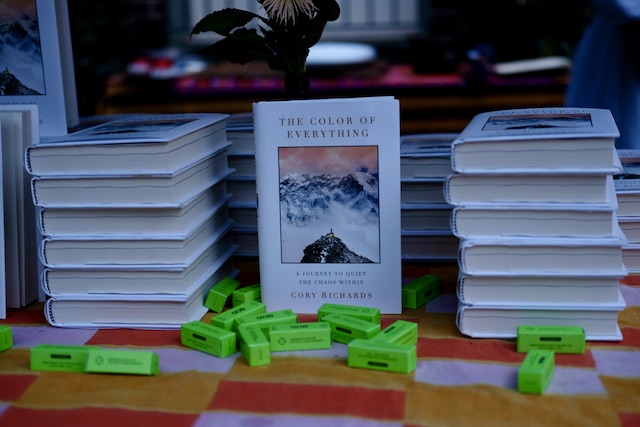
“This book is birthing here because of the generosity of Brandy and Wes and Sound Future,” Richards says, “And so many of the experiences I describe in the book happened when I was living in Boulder.” While Richards has since moved to L.A., he describes the formative years of his career and adult life in Boulder, where he still owns a house, and how this book celebration was destined for the Denver market. “I feel so connected to this place, this environment. Denver is an incredibly vibrant art scene. So much comes out of here and it’s special. This is a homecoming to me.”
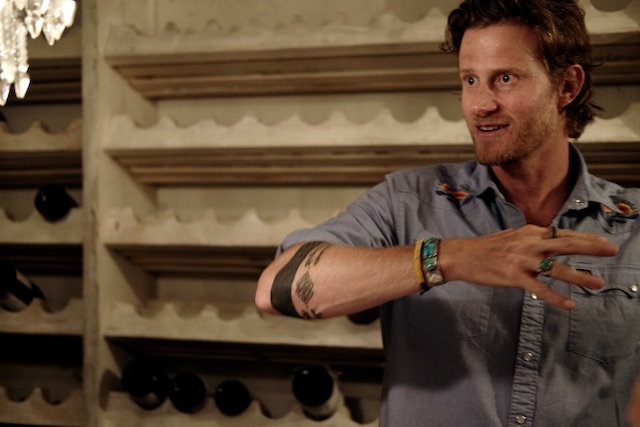
“We are breaking the stigma of mental health, but the story we often tell about it is one of brokenness. My belief is, that’s fundamentally flawed,” Richards says. “You’re not broken. You have a health complication that’s based on your neurobiology that is not necessarily permanent. Even if it is a lifelong journey, it doesn’t need to hold you captive.”
For Richards, a journey makes an ideal metaphor, considering he’s the first and only American to climb one of the world’s 8,000-meter peaks in the winter. He adds this memoir to his cache of notable creative projects, including the award-winning documentary about his winter climb, Cold. Amy Ellis Nutt, Pulitzer-prize-winning journalist and author of Becoming Nicole, calls the The Color of Everything, “An extraordinary memoir of mental illness that reads like a thriller. [It] is filled with brilliance and bravado, breathless in its pace and breathtaking in its consequences.”

“This book took me 43 years to write,” Richards says. “It’s like an onion, using the trajectory of life as the outer layer to hold a dissection of mental health, psychology, and how the brain works, to the best of my understanding. And the central nugget of it offers that, consciousness, as a whole, is storytelling. We wake up in the morning, we tell ourselves a story, about ourselves, about the world—about everything. We live and die by those stories, they drive our beliefs, and our beliefs drive our actions.”
Fans of Richards’s distinguished career will recognize in his writing the same daring stance he uses to frame a picture—whether hanging from a literal mountain or dangling from the edge of his own interior life. “I’ve always interpreted and felt the world in very visual ways,” he says. “When I was shooting for National Geographic, I learned a lot about narrative arcs. How to represent specific pieces of a story in a singular, gripping way that tied to one another. I could lean into the instinct of what was important and what wasn’t to tie that greater thing together.”
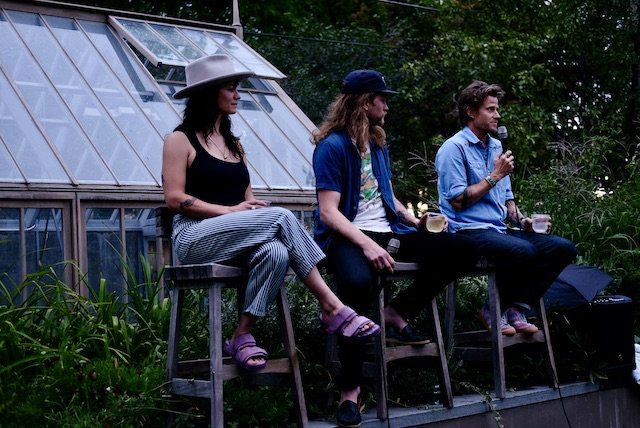
Long-time friends of the Schultzes, Richards returned to Colorado hoping to make his story accessible and relatable to the community in the place he still calls home. “We all have unique trauma and pain,” Richards says. “That is related to how we navigate the world. I started writing this book to be seen, to get [my own trauma] out. It’s my story, but it’s not about me. It’s about allowing other people a space to feel validated in their own experiences.”
Richards shares his own story of growing up, his early bipolar diagnosis, and the traumas that drove him into adventure-seeking and beyond, hoping that others may use it as a jumping-off point to intentionally nurture their mental health.
“The skill here is mindfulness: how are you telling stories, what is the narrative you’re creating? This isn’t storytelling like the hero’s journey. It’s being acutely aware of the stories we’re telling ourselves and others in our day-to-day lives,” he says, explaining further how he’s learned through this journey that storytelling is more than a narrative arc. “It’s granular. And that’s meaningful when addressing mental health. It helps break the story of being broken.”

The Color of Everything, available wherever books are sold, is not photography-forward but does feature photos from Richards’s childhood and select adventures around the world. Richards is also sharing excerpts and insights into the writing process in interviews, podcasts and on his Instagram.