



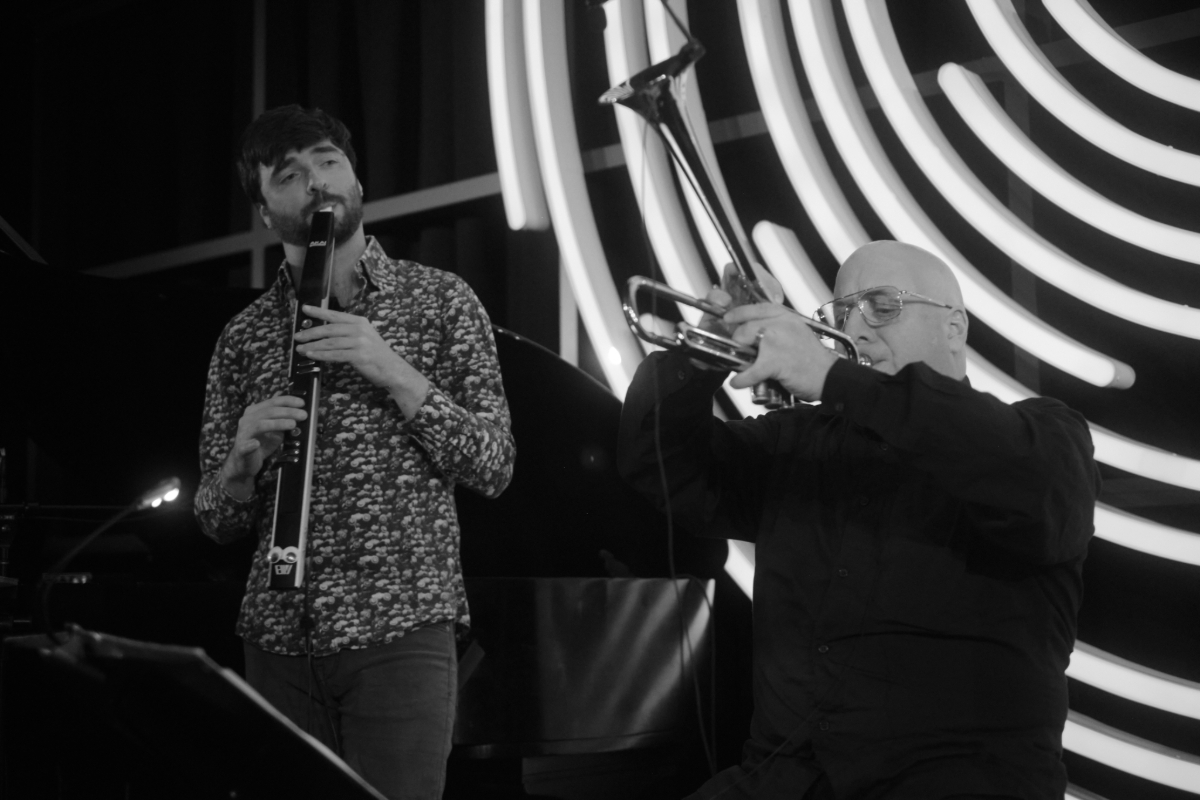
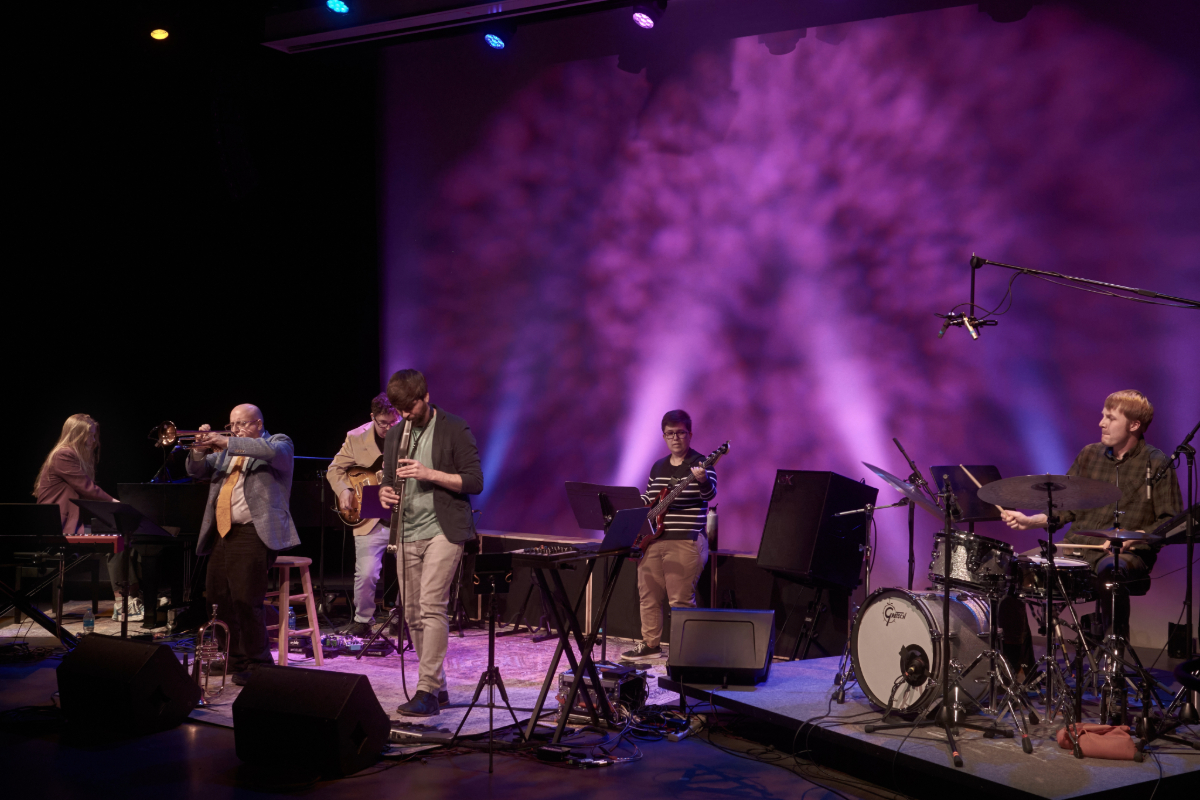
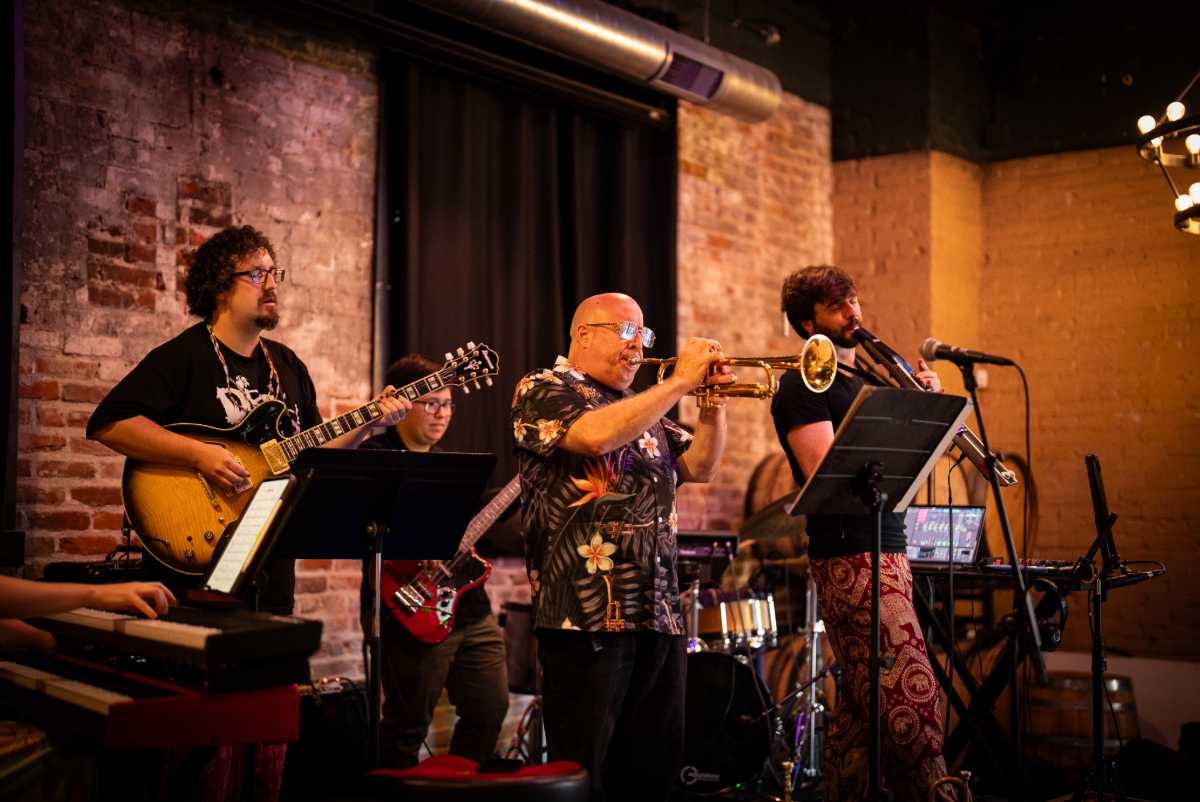
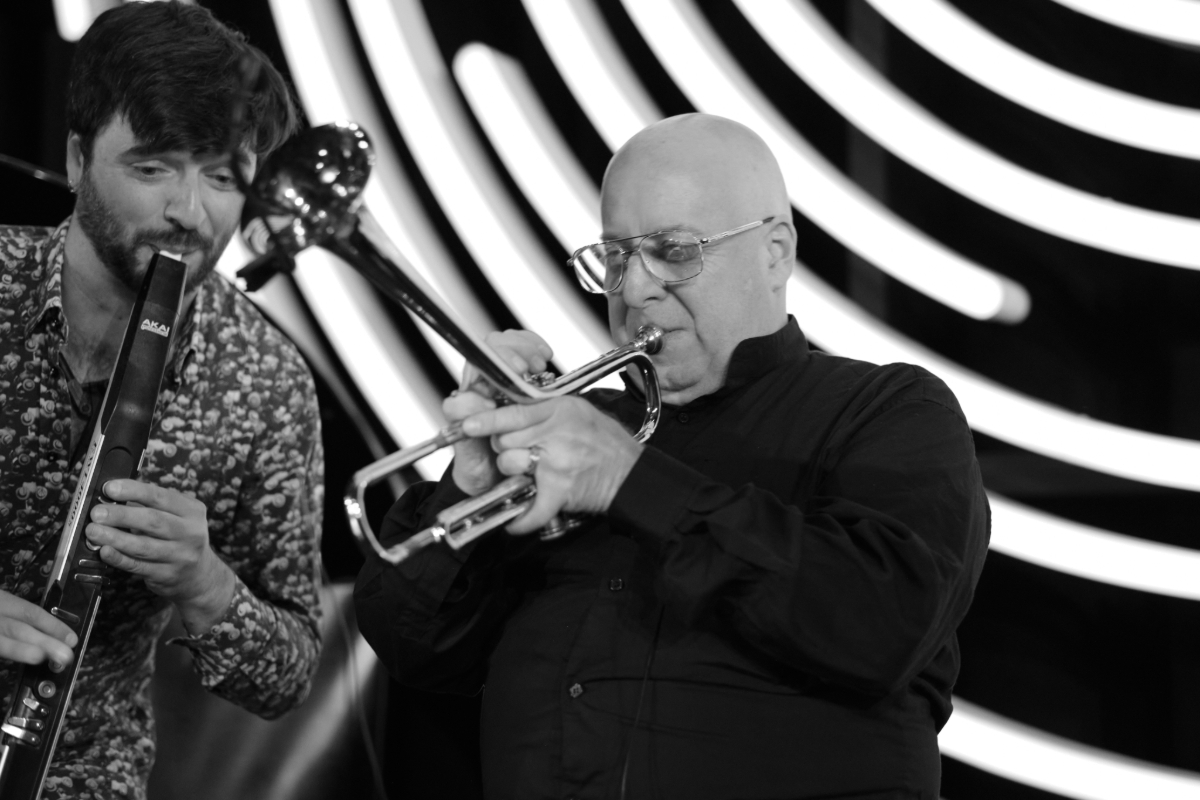
Local producer, songwriter and multi-instrumentalist Mickey Lenny — real name Michael Lenssen — has been something of an unsung hero in the Denver and Boulder music scene for about a decade now. He’s been incredibly prolific through the years, mainly within the local jam scene. He was integral member of the beloved but now defunct Boulder-based jam project Amoramora in which he played keys, trumpet and much more. He’s sat in with countless other projects including the also now defunct Tenth Mountain Division and many more. These projects meant a lot to a lot of people as they went through college and began to figure out how to navigate the world and still live on in the hearts of those that were there to see them. Sometimes endings such as these feel devastating, all-encompassing but many times they turn out to actually be beginnings. This is the case for Lenny, who now finds himself stepping out of supporting roles into co-leading a new jazz project: Electric Giz. The project takes a non-traditional approach to jazz, drawing on a wide range of influences as well as Lenny’s experiences in the jam scene and this approach has earned the band a monthly residency at the beloved Denver jazz institution, Dazzle.
303 Magazine caught up with Lenny to talk about the residency, his musical history, the commonalities found between the jazz and the jam genres, how Electric Giz came together and much more.
303 Magazine: Hey man! How’s it going? So glad we were able to put this together.
Mickey Lenny: Yeah, man. Great to see you! I am too.
303: Well, I don’t want to take up too much of your time. I usually like to start these out by giving you a chance to tell me a little about who you are and what you do in your own words.
ML: I would say, at the core of it all, my goal in life is to help people feel and how that’s happened has mostly been through music and conversation. But that has taken some different forms over the course of my career. As far as playing in bands, early, early on, it was very much focused on improvisation. As my 20s waned, I started to really confront the fact that I was a composer who wasn’t composing. I was a writer who wasn’t interesting doing the final step of putting it out in the world. I was filling up notebooks and it wasn’t going past that.
Just about three years ago, Greg (Gisbert, trumpet player and co-founder of Electric Giz) and I did our first collaboration where I was more than just a tech person. We collaborated with a guy who had done a lot of set design for Breaking Bad and Better Call Saul named Andy Linderkamp over at Understudy Art Incubator. At that point, I had a bunch of music that was pretty much done but I hadn’t booked a gig. I hadn’t booked the rehearsal to actually finish it so we did that show. We were all dressed up as cavemen being approached by aliens with music. Since then, I’ve been really like actualizing the transition from just a player on the scene to a writer, a producer, a little bit more of a studio guy.
I’ve really been following my passion for sound design and combining groove with simple melody. I think the jazz world that I originally came from didn’t have enough of that for me which was was how I ended up spending so much time in the jam world.
303: I do want to talk more in depth about that and how the jazz and jam worlds overlap but first I want to go all the way back to the early days. When did you first start becoming interested in music? Were there certain things played in your home growing up that really stood out to you? Where did it all start?
ML: I started playing violin right around when I turned five. My older brother was doing it and I was like, “Hey, I want to do that.” That was my first instrumental experience. And my dad is just a huge music lover. I distinctly remember hanging out with one of my earliest friends just staring at the album cover of my dad’s copy of Herbie Hancock’s Headhunters with the big balloon. I mean, [the album is] alien sounds but I distinctly remember staring at that cover when I was six or seven. I would say my dad mostly influenced me in the classical and jazz directions but he’s also a big fan of The Grateful Dead and of bands like the Talking Heads.
When I was in either third or fourth grade, I met my best friend, whose entire family was all about music. His dad was the bass professor at CU for about 40 years, until a couple years ago. I think my first transcendental, almost drug-like experience with music was when he brought over a couple musicians from India with wooden flutes and tablas and I was sitting in another friend’s living room about three feet away from them and just taken into this world of this Western Indian fusion. That has stuck with me to this day, as far as the the influence of Eastern harmony, melody, as well as the idea of how to combine two things that might not be the most obvious to combine. That’s what led me to the jam band world and is still really what is at the core of what I do today.
But from fifth grade, I was in the instrumental music program we have out in Colorado. That’s when I started playing trumpet. I was involved with local youth orchestras and this awesome organization called Colorado Conservatory for the Jazz Arts (CCJA), which I think they’ve been doing for about 25 years now. I owe so much of my everything to that group.
303: That’s really cool you were able to have so many places to be immersed in it all so young.
ML: Yeah, man. When I was 18, I did a recording camp with [CCJA] where you bring in a song, you go in the studio and a week later you leave with the recording. That was really the first song I ever wrote. And it just so happened that Greg was the producer on that set. I just remember him telling me, “Man, you’re a writer. I want to record that tune some more.” For a kid to have one of your all time heroes say that to you, I think it scared me so much that I didn’t finish a tune for a couple of years after that, you know? And once there’s those expectations, external, internal, it’s so much harder to just show up and write something that might suck.
303: I hear you. It almost can make things harder once you get that validation and then feel you have to chase that same level of excellence but you can start to believe that you’ll never quite attain it again. I think that’s something a lot of young, creative people, regardless of medium, experience.
ML: Exactly.
303: Well, it does sound like things are coming pretty full circle. I’m curious how and when you transitioned from the jazz world to the jam world.
ML: One of my other big mentors is one of the godfathers of music in Boulder named Art Lande. He is just a true master improviser and he lives in such a beautiful, free-flowing way. I started hanging with him and really going, some might call it off the deep end, into creative music including showing up and playing sounds with people before you ever talk to them. It’s like, “All right, we’re gonna make some shit up on the spot right now.” I found that to be a huge influence, as well as when I was in school in Miami. I always knew I didn’t want to just play straight ahead jazz. In my opinion, it’s been done by people who have more to say than I do. So I ended up playing in the funk fusion ensemble every year when I was in Miami. I think the professor who ran it was kind of sick of me by the end. [Laughs] But there I was messing around with trumpet effects at that point. I was starting to play some EWI (Electric Wind Instrument). Not a ton but that was very much on the forefront of my mind, thinking, “I know I have no interest in regurgitating or trying to live in a world that feels like it’s been done already by the greats.”
When I was in Miami, I was pretty much exclusively going to electronic shows. My first psychedelic experience was at Ultra Music and I saw Skrillex and Pretty Lights and Porter Robinson and Madeon all around that time. Flying Lotus was big for me then, too. Then I started seeing bands like Hiatus Kaiyote start to take off and all these other jazz-adjacent things became very exciting for me. Tigran Hamasyan was a big one for me in terms of that prog-rock/metal influence. I’ve also always loved bands like Dream Theater and System of a Down. I’ve always loved the jazz world but felt like I was always looking for more.
303: I think it’s important these days to draw from so many places and genres creatively. I’m curious, as prolific as you’ve been over the last 10 years playing with all the groups that you’ve played with, are there any specific memories or lessons that you’ve taken from your time in the jam world that you now apply to Electric GIZ?
ML: Yeah, absolutely. I think the biggest reason I’m still drawn to the jam community — besides that fact that I just love it — is the shapeshifting elements of it. The tune that I’m currently working on finishing up for rehearsal is a great example of that. It like starts in one vein, then it kind of starts into this like march thing that goes into some uptempo funk, and then I’m gonna kind of drop into a Samba, I think, and we’ll see what happens after that. That’s where I’ve struggled a bit with even describing the music, because we’ll be playing a two-chord trap beat where nobody’s playing an acoustic instrument except the trumpet player and then we’ll drop right into something that’s much more influenced by like African High Life. And then, you know, into something that’s a little more on the prog, Lespecial kind of influence.
303: I think you raise an interesting point about jam in general. Jam is such a blanket term. It’s such a huge genre that there’s so much that can fall within it. And I think that’s that’s something that a lot of people outside of the jam world don’t fully understand: just how amorphous it can be.
ML: That’s exactly why I love it so much. It never has to be just one thing.
303: Well, tell me how the Electric Giz project came together. How did you and Greg actually start working together?
ML: Well, there’s three main events that really led to us working together. The first was when I was 18 at jazz camp and I came back from lunch smelling like weed. He told me just to spray some Axe or something on myself and I’d be good. That was the first time I felt that we spoke really as peers. I wasn’t just the kid anymore.
Next, I’d say around 2016 or 2017, we were jamming and I was playing around with trumpet and vocal effects. I’d been messing around with that for a while and it was just a one off thing. We met up at an art studio at like 11pm and just made some sounds and then went along with our lives.
Then, a few years later, he called me at like 7am. This is like a week after I quit Amoramora (Boulder-based jam band in which Lenny played keys, trumpet and more). He called or sent a text saying something like “Man, are you available? Can you help out with trumpet effects for the upcoming (Grammy Award winner) Maria Schneider album? She wants me to use trumpet effects and I don’t do that.” Maria is like one of the absolute titans of the music world. She worked with David Bowie, has done some quartet arranging for Phish. She’s one of the most incredible people and musicians I’ve ever met. And that was really the start of us working together.
303: That’s honestly so cool but must have been intimidating.
ML: It really was both. Next thing I know, she’s flying me out to New York for the session. Being the young guy who got his toes in the room, I just was like, “You need somebody to go to the hardware store? You need a soda? I’ll do whatever.” And then Greg — who a lot of people call “Giz” — and I were sharing a taxi back into the city after the session and we got talking. And it was like the joke of Electric Giz as a name was born in that taxi ride.
Not too long after that COVID hit and everything got a little squirrely. In that time, I started to really sit down with Ableton a whole bunch, and was doing a lot of these kind of journaling practices where I would make a point to sit down every day and make something. I’d say 80% of the original Electric Giz tunes came out of those sketches.
The process was I would do all of them, and then, a few months later, I’d go through and sort them into these different categories, like, “Oh, this could work with a wide band. Oh, that’s more like ambient, down tempo, electronic.” Once we started doing that art exhibit and talking about that art exhibit with Andy, winter came. I realized, like, “This is the opportunity to book a gig and figure it out.” This was just about three years ago and I was in the middle of quitting smoking weed because I realized I wasn’t able to finish music while I was stoned all the time. The first gig was almost a rehearsal of sorts and we didn’t think too much of it. A year later, Dazzle was moving to their new location in the Denver Performing Arts Complex and they reached out to Giz and said, “Hey, we’d love to do a week in residence with you.” I think it ended up being four or five nights, and Greg came to me and said, “Hey, this, let’s do it.” That was the first show that really felt like “This is the thing”. We hadn’t added our bass player yet at that point. That was just about two years or so ago. And then our next gig was at Five Points Jazz Festival. Now, we’ve played a little over a dozen times this year.
303: I do want to talk about the Dazzle residency but first has that process, like your writing process, I mean, has that changed at all in the time since COVID?
ML: The big development in my writing process was learning and developing trust. I think that’s where Ableton was so necessary to be able to kind of just tinker and follow sound, rather than writing on a piece of paper. You have to know how that will translate and a few years ago, I didn’t quite have that. So pretty much everything from the original eight tunes that we had, all of those were very much made in conjunction with the gear.
More recently, I would say — and this has always been somewhat of the case — I’m doing the follow through. Whether I’m driving home from a friend’s place, I’m improvising with my trumpet or on the piano, I just hear like, “That was a tune” and pull up a voice memo, sing it, play it, whatever it is and then translating that into the computer or onto the page. That’s been much more of a driving force lately. And I’m sure it’ll swing back around to more sound design influence. But I think really just being open to the fact that ideas can come from anywhere has been the biggest change. It’s just your job to do the follow through.
303: Does that apply also to booking gigs?
ML: I describe it as almost reluctant adulting. I was talking to a poet a few years ago and she said, “Well, it’s not really done until you get it out in the world.” For me, I need that deadline. I’ve turned down like, three or four different plans this week because I know if I don’t sit in this room and put my phone outside the room and turn off all the internet that I’ll show up to rehearsal on Sunday and won’t be content with my level dedication.
There’s a quote from a book called The War of Art by Steven Pressfield: “I write only when inspiration strikes. Fortunately, it strikes every morning at nine o’clock sharp.” I think that attitude, so much of that is trust. I know I have an incredible band of musicians that will tell me, “Hey, this chord doesn’t make sense,” or I can leave something blank and they’ll say, “Hey, what do you think should happen here?”In my opinion, that’s the best way to work with other people, to leave them space. I’m not trying to go full Zappa and own people’s lives. [Laughs]
Also, if you do only wait for the lightning to strike, you won’t have the skills to do anything with it.
303: I do want to talk about a bit about your place within the Denver jazz scene. Electric Giz is decidedly non-traditional but are now playing consistently at one of the most celebrated jazz clubs in the city. How does that feel?
ML: It’s funny because I have felt so not part of the jazz scene and I still don’t really. I have friends in the scene, but I feel like I’m more likely to be on the other side of the glass. I just produced a recording session that was very much in the jazz band and I was on the right side of the glass. That’s where perception is such an interesting thing: because I’m playing at Dazzle, I feel more accepted in the jazz scene and because I’m playing with these jazz musicians now, the fact that I’m playing this unconventional electronic instrument (EWI) is more celebrated where I’ve gotten some pretty negative feedback from more traditional players. Some of those same people kind of have flipped their script over the last five years, which is interesting.
303: It’s almost like you now have this pedigree that maybe you didn’t before and now y’all are playing the last Friday of every month at Dazzle. How did the residency come about?
ML: I started going to Dazzle probably around 2020 — years ago at this point — and most of the shows I caught, especially early on, were Greg’s band, Convergence, who, I don’t remember what day, but they had a monthly residency back when the club was at Ninth and Lincoln. He’s had a very long standing relationship with them. He grew up playing at El Chapultepec before he went out with Buddy Rich. So he has the Denver jazz connections. He was inducted into the Colorado Jazz Hall of Fame last year. He’s the real deal. We started playing at Dazzle and did two shows there that both sold out. After that second one, I reached out to Nick, the main talent buyer over there, and said, “Hey, we’d love to get something else on the books?” He said, “Sure, I’m into that, or would you want to do a residency?” And it was really just as simple as that, having a relationship with this club, a long-standing relationship.
I also think they wanted to do more than just the traditional music that they have been doing, while continuing to support the traditional stuff but they’re always looking for what else is going on and what might attract a bit of a different crowd.
303: Well, man, I really only have one more question for you and that’s what else do you and Electric Giz have on the horizon?
ML: We’re gonna go into the studio this fall for the first time. I think both Greg and I really value growing a band in an organic way in which you learn how to play together rather than just trying to manufacture something in the studio. It’s all heavily influenced by tech and there are very orchestrated, written-out parts of the songs, but there is a also big element of improvisation and the human chaos, that controlled human chaos. Having Randy Becker on this next show is so sick, so exciting for us and I really hope to use that as kind of a tool to work on getting on more festivals next year.
I think one of my main goals is to get out of the jazz club. We played on an outdoor stage once and it just made so much sense. Volume wise, we’re not the quietest band. It doesn’t always translate the best in a small room where it’s designed for acoustic music. We can play that way. But I want it. I want to let the guitar player turn his amp up.
As far as other things going on in my life, I have this duo project with Sonia Walker — who plays keyboard in Electric Giz — and we’re called Prototype and are really exploring downtempo and electronica and ambient. That project has a few festivals on the horizon including Lafayette Music Festival.
Beyond that, I’ve been teaching at Justice High School for like, seven years now. And that’s helping out and giving kids who really need it a creative outlet. They’ve been in juvie or been kicked out of other schools. It’s kind of their last chance at a high school degree. I think we all need some form of creative encouragement and our education systems aren’t really designed to focus on the encouragement but that’s a whole other soapbox.
303: Alright, man. Well, I have to say this has been such a great conversation and thank you for taking the time.
ML: Thanks man!
Get tickets to Dazzle here!
[give_form id="772002"]